
Mapping the Invisible: Why Where You Live Dictates What You Breathe

We often think of our health as a product of our daily choices: the food we eat, the exercise we get, the sleep we prioritize. But for millions of people—especially those suffering from CIRS (Chronic Inflammatory Response Syndrome) or mold sensitivities—health is dictated by something far less visible and far more pervasive: Geography.
At Moldmap, we don’t rely on guesswork. To understand the true scale of the indoor air quality crisis, we aggregated millions of data points across climate science, insurance history, and housing infrastructure.
The results challenged the common narrative. The United States is not a uniform landscape of risk; it is a patchwork of "danger zones" where environmental conditions make mold almost inevitable without strict intervention.
Here is what the data tells us about the invisible war happening in our walls.
1. The Moisture Baseline: Relative Humidity
Humidity is the engine that drives mold growth. While mold can grow anywhere with a water source, ambient humidity creates the "baseline" load for a building.
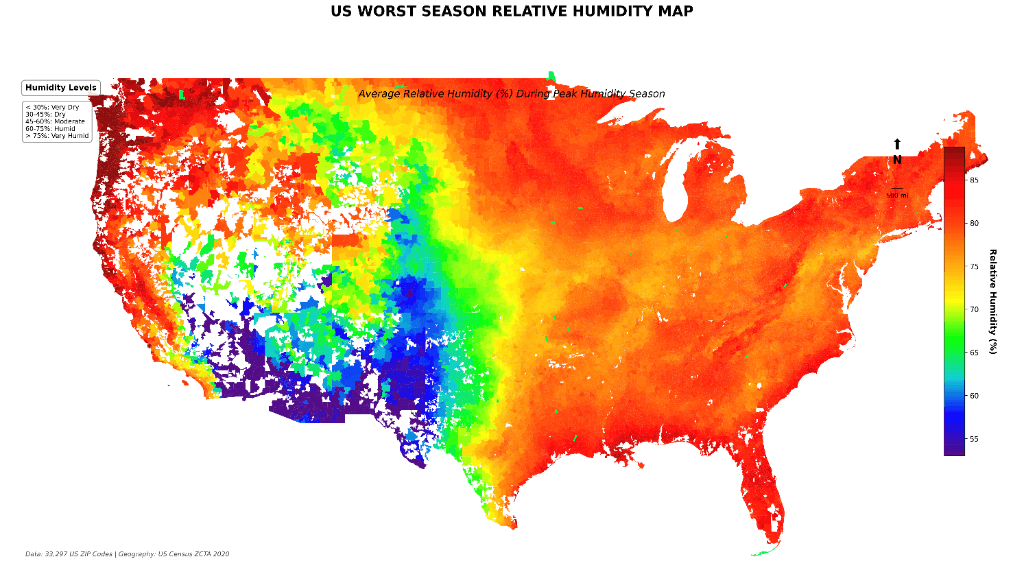
Figure 1: The Eastern Seaboard and Deep South consistently exceed 75% relative humidity during peak seasons.
Our analysis of the US Worst Season Relative Humidity reveals a clear divide. The entire Eastern Seaboard and the Deep South consistently exceed 75% relative humidity during peak seasons.
The Risk: When outdoor air is this saturated, opening a window or having a leaky building envelope doesn't just let air in—it lets water in.
The Reality: In these red zones, HVAC systems are not just cooling devices; they are life-support systems. If they fail to dehumidify effectively, the indoor environment reaches the "tipping point" (60%+) for fungal growth within hours.
2. The "Sticky" Factor: Dew Point Analysis
Relative humidity tells us how "full" the air is, but Dew Point tells us how it behaves.
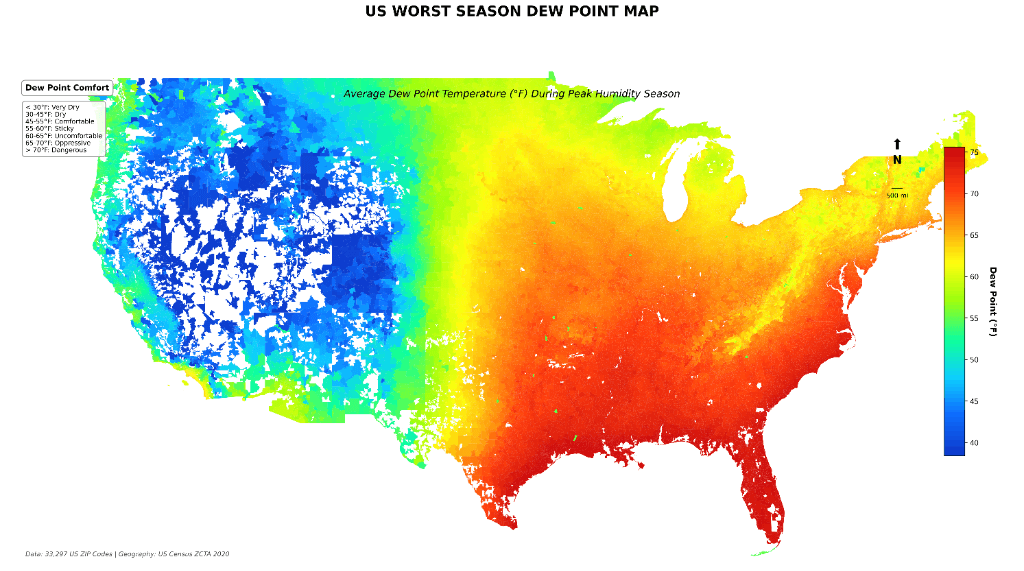
Figure 2: Dew point analysis reveals zones where condensation is most likely to occur.
This map highlights the "Oppressive" and "Dangerous" zones (shown in red/orange), where the dew point exceeds 70°F. This is critical because dew point dictates condensation.
The Science: When this hot, heavy air hits a cold surface—like an air conditioning vent or a cold water pipe—it instantly releases its water.
The Consequence: This creates "hidden moisture." You might not have a roof leak, but you have wet drywall behind your AC unit simply because of physics. For the Moldmap community, these zones require aggressive dehumidification strategies that go beyond standard building codes.
3. The Reality Gap: Flood Zones vs. Actual Claims
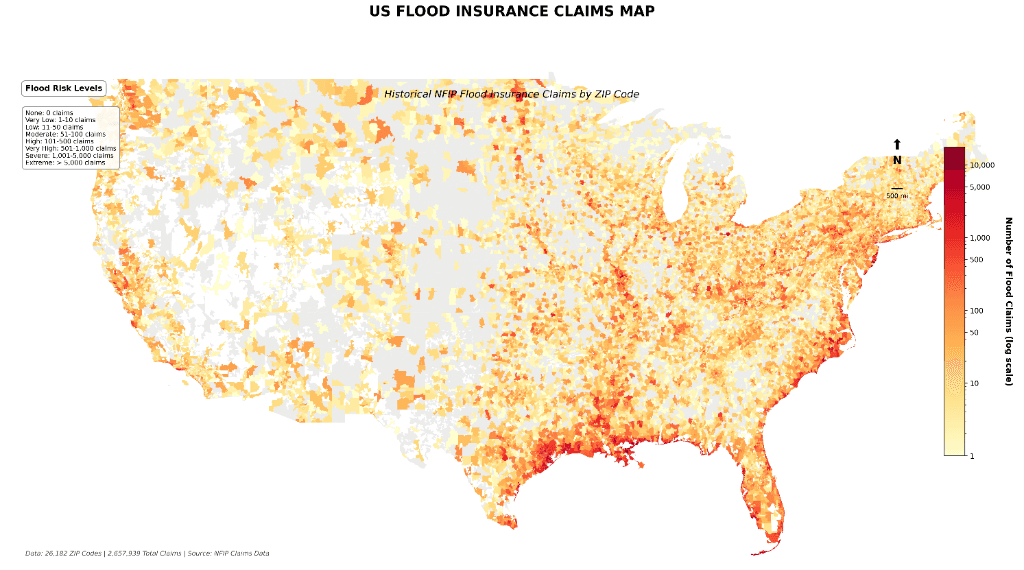
Figure 3: High density of flood claims often appears outside official FEMA zones.
One of the biggest misconceptions in real estate is: "I'm not in a flood zone, so I'm safe."
Our data suggests otherwise. By layering FEMA Flood Risk Zones against actual NFIP Insurance Claims, we found a disturbing gap.
The Lag: FEMA maps are regulatory; they often rely on outdated topography and do not account for rapid urban development or changing weather patterns.
The Reality: The "Claims" map reveals that water damage frequently occurs outside the designated zones. For a mold-sensitive individual, relying solely on official flood maps provides a false sense of security. Historical water damage—regardless of the "zone"—is the strongest predictor of current fungal load.
4. The Shield: Median Year Built
Climate is the external threat, but the house is your shield. The Median Year Built map serves as a critical proxy for safety, and the data points to a clear trend: Newer is often safer.
The Legacy Risk (Pre-1980): Older homes have simply existed longer. They have endured decades of storms, pipe bursts, and roof leaks. Even if "fixed," these events often leave behind dormant fungal reservoirs in wall cavities that can reactivate with high humidity. Furthermore, older foundations are more porous, allowing groundwater intrusion.
The Modern Advantage (Post-2000): Newer construction typically follows stricter building codes regarding moisture management. With modern vapor barriers, better foundation waterproofing, and PEX plumbing (which is less prone to corrosion than old copper), newer homes generally offer a "clean slate" with significantly lower chances of established microbial overgrowth.
5. The Vulnerability Index: Socioeconomic Status (SES)
Clean air should be a right, not a luxury. Unfortunately, our data shows a troubling overlap between lower Socioeconomic Status (SES) scores and high environmental risk.

Figure 4: Lower socioeconomic status areas often correlate with higher environmental risk.
The Justice Issue: In many of the purple and blue regions (Lower SES), residents are more likely to live in older housing stock with deferred maintenance.
The Compound Effect: When you combine a high-humidity zone with a low-SES area, you often find buildings with poor insulation, older HVAC systems, and landlords who may cut corners on remediation. This creates a trap where the most vulnerable populations are exposed to the highest fungal loads.
The Moldmap Mission
We visualized this data not to scare you, but to arm you.
For too long, mold has been treated as a hygiene issue or a housekeeping failure. The data proves otherwise: Mold is an environmental and infrastructure challenge.
Whether you are navigating a chronic illness, looking for a safe apartment, or just trying to optimize your health, you cannot ignore the map. This is why we are building Moldmap—to crowd-source the data that fills in the gaps between these maps, helping you find the safe havens in a risky world.
Join us today and start mapping your air quality today!
Find Your Next Healthy Stay
Browse thousands of hotels and rentals with verified air quality data
Become a Member